
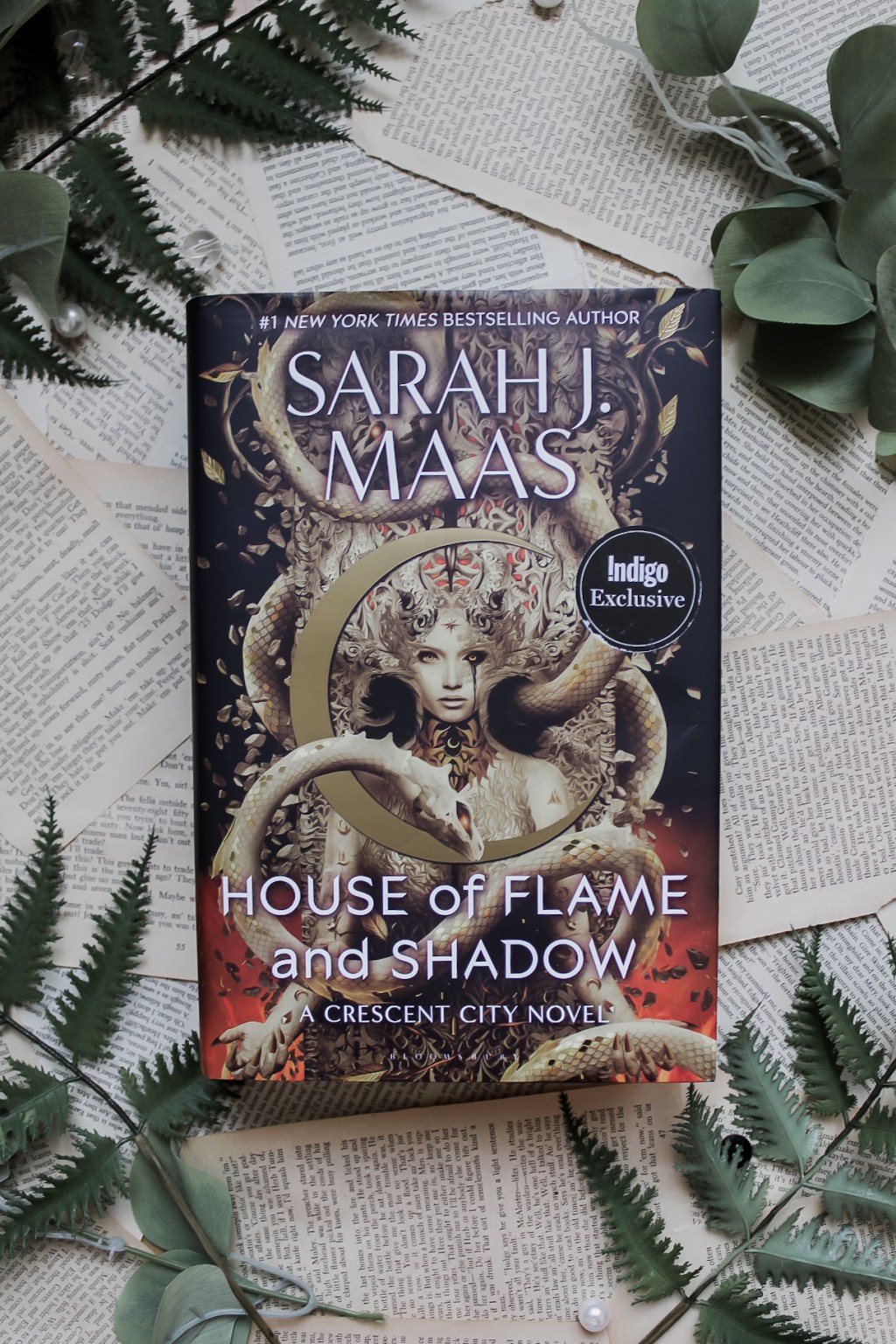
Title: House of Flame and Shadow (Crescent City #3)
Author: Sarah J. Maas
Genre: Fantasy romance, romantasy
Publisher: Bloomsbury Publishing
Publication Date: January 2024
Format: Hardcover
Length: 838 pages
Read if you like: the Maasverse, epic quests, found family, urban fantasy, the chosen one tropes, multiple POVs, multiverse concepts
Rating:
House of Flame and Shadow by Sarah J. Maas was easily my most anticipated release of 2024 and it didn’t disappoint—though perhaps not for the reasons you’d think. Now that the book has been around for a few weeks, and I’ve had time to digest my experience with it, I’m feeling more articulate about why I loved it so much when for others, it fell a little flat.
I’m going to save all of my analysis and review for below because I know that so many people are still desperately trying to avoid spoilers for this book, so this is your warning: if you’re avoiding everything related to HOFAS still, best not to read my review today! I’ll be digging into some of the meatier aspects of the plot and you may encounter a spoiler for any one of the Crescent City books. Proceed with caution from here.
The Book Synopsis: House of Flame and Shadow by Sarah J. Maas
Bryce Quinlan never expected to see a world other than Midgard, but now that she has, all she wants is to get back. Everything she loves is in Midgard: her family, her friends, her mate. Stranded in a strange new world, she’s going to need all her wits about her to get home again. And that’s no easy feat when she has no idea who to trust.
Hunt Athalar has found himself in some deep holes in his life, but this one might be the deepest of all. After a few brief months with everything he ever wanted, he’s in the Asteri’s dungeons again, stripped of his freedom and without a clue as to Bryce’s fate. He’s desperate to help her, but until he can escape the Asteri’s leash, his hands are quite literally tied.
The Review
Like so many Maas fans, I have been eagerly waiting for House of Flame and Shadow since the jaw-dropping last line of House of Sky and Wind left me gasping on my couch. This book had a lot to live up to, because the ending of the last one? DAMN.
From the second that I sunk into the first chapter of this book, it felt like wrapping myself in a warm Maas blanket. This wasn’t because the content was particularly warm and fuzzy—in fact, you’re thrown right into the deep end of several different kinds of trauma, but everything about the writing, the characters, and the unfolding of the plot is so incredibly familiar and Maas-like that if you’re a fan of her series, you’re immediately immersed in the very same way that you’ve been before. I found myself sucked directly into the whirlwind of characters (and there may be more perspective shifts in this book than any of Maas’ other works) and found it difficult to come up for air.
The plot itself had her characteristic twists and turns and while some I saw coming from further out, many I did not. This might have been owing to clever plotting and foreshadowing, or honestly, it could have been because of the sheer number of storylines that were on the go at any given time. We got to see a lot of Bryce and Hunt as expected, but Maas also flowed through Ruhn, Lidia, Tharion, and Ian. She also collectively managed to tell the stories of Jesiba, Baxian, Hypaxia, and more through the perspectives of others. It was a lot, but the stories moved so fluidly that I didn’t feel bogged down by it. I loved that she didn’t dedicate full chapters to character perspectives, but instead seamlessly moved back and forth between them in the moment, as the action called for it. By the end, I was living for the storyline between Lidia and Ruhn, but seeing Bryce and Hunt work through their traumas and own who they were meant to be was equally satisfying.
I will say that thematically and in terms of overall vibes, House of Flame and Shadow felt A LOT like the Throne of Glass (TOG) series. The action felt similar, as did Bryce’s manipulation and maneuvering (very significant Aelin vibes), and this particular instalment was considerably less spicy than some of the later ACOTAR books– an aspect that was a highlight for me, not a miss. I also felt like the massive cast, many of whom received a lot of attention, was more similar to TOG than to ACOTAR as well. There were references across the whole Maasverse, as was presented in the previous book with a direct tie-in to ACOTAR, but as a whole, I felt like the series felt most similar to TOG, which wasn’t a negative for me either since I enjoyed that series immensely.
For me, this was a 5-star read for the same reason that for others it’s ranking lower, and that’s because it was pure Maas. She leaned on her favourite tropes, she wrote it in an exceedingly familiar style, she had similarly swoon-worthy romance arcs to her previous books, and there was an excessive amount of action in her typical style. I’ve seen a lot of people feel like this book didn’t contain anything earth-shattering and that some of the storylines didn’t really come to conclusions, but to me, that wasn’t even remotely surprising. Maas does have a specific style and several tropes and devices that she likes to lean on, and they just so happen to coincide with my reading interests. I’ll also say that in defense of the stories that she didn’t wrap up or that didn’t feel as valuable at the time as well: that’s kind of her thing. She almost always leaves things open-ended and comes back to characters as she sees fit, and she’s been pretty transparent that she hasn’t closed the book on most of her worlds, this one included. Does anyone recall Tower of Dawn?? I almost didn’t read that book because I literally could not have cared less about the secondary characters she was highlighting and somehow she made me love them. The same goes for A Court of Silver Flames, which wound up being hugely important in the Maasverse later on. While some of these side perspectives felt less relevant or interesting than our main heroines and heroes, I’m quite sure they’ll hold significance in her future stories. There weren’t really any stories that I didn’t personally enjoy either, except maybe Ian who just felt kind of idiotic, but in a super young, still finding his path kind of way.
I’m certainly not judging anyone for not loving this book, because I can 100% understand wishing that Maas had taken more risks, or focused more on fewer characters, etc., but I found this book so comforting. It was a reminder of why her books are so lovely to me, of the feelings I had the first time I picked one of her books up and lost myself for hours at a time. Maas could continue writing with the same characters and the same tropes until the end of time and I think I’d still pick up every last book because they’re just so solid for me. I loved how easily I fell back into this universe, and I’ll be eagerly awaiting the next opportunity to jump back in again.
 forests and fiction