
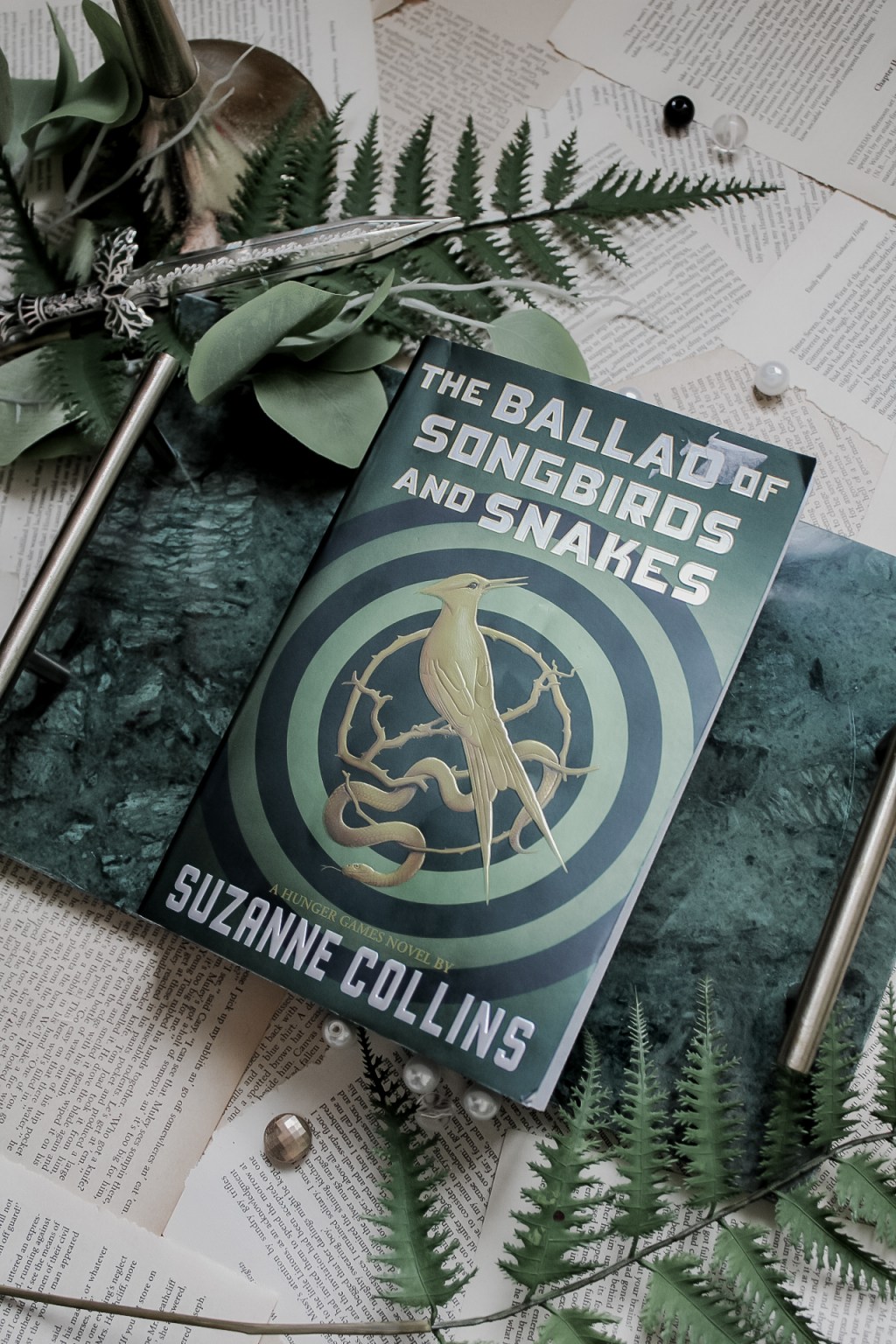
Title: The Ballad of Songbirds and Snakes (The Hungers Games #0)
Author: Suzanne Collins
Genre: Young adult, dystopian
Publisher: Scholastic Inc
Publication Date: 2020
Format: Paperback
Length: 517 pages
Read if you like: the original Hunger Games series, grey and black morality, ambition at all costs, sinister villains, political scheming and manipulation, deadly competitions
Rating:
Like many, I was obsessed with The Hunger Games when I was younger. I can vividly remember reading all three books in a marathon fever dream in my dorm room while I ignored every paper and academic responsibility I had until I’d finished. I put off reading The Ballad of Songbirds and Snakes because frankly, I was worried it wouldn’t live up to the original series. Was I ever wrong to worry!
I loved this book so thoroughly. Coriolanus Snow to me is such a peak villain, so truly reprehensible and irredeemable that I half expected Collins to introduce him as an overt sociopath, but what she did was so much better: she humanized him. There are certainly quirks and traits that are obvious heralds of who he would become, but we also see what shaped him, and the many opportunities he had to make different choices than what he did. I was simultaneously rooting for him and repulsed by him, but by the end, I understood how he’d become who he was and how quickly he could have descended into an even more desperate level of villainy.
This is one of my favourite prequels I’ve ever read. I loved seeing Snow’s villainous arc and loved getting to see the history behind The Hunger Games and how they become the monstrous events that they are in the original series. This was such a fantastic book that I know it’ll stick with me for a long time, and if you were a fan of the original series, I can’t recommend it enough.
The Book: The Ballad of Songbirds and Snakes by Suzanne Collins
The Ballad of Songbirds and Snakes is set during the tenth annual Hunger Games. The devastating war that nearly levelled the entire world is still achingly fresh in everyone’s minds, and the districts and the Capitol have never been more stratified. While some manner of luxury has returned to Capital citizens, many are still deep in recovery and nowhere near the illustriousness they’d lived in pre-war. In the districts, things are as bad (if not worse) as they were during the war as well.
Despite a decade of forcing all of Panem to be passive participants in the Hunger Games, both Capitol and districts alike find the event unnerving at best, and repulsive at worst. The Games are struggling to attract viewers and have the impact originally intended (namely to keep the districts in their place), and so, to reinvent the Games, a group of students from the most elite school in the Capitol are tapped to be the children’s first-ever mentors. They’re tasked with coaching their tributes and presenting them to Panem and are assigned the effort of trying to find new and exciting ways to get the people of Panem to participate more actively in the Games.
Coriolanus Snow is one of these chosen students, and the stakes for him are even higher than his peers. The Snow family has fallen to ruins since the war, and without the prize promised to the victorious mentor, he won’t be able to afford to attend university. He and his cousin Tigris have worked hard to hide the true depth of the Snow family’s desperate situation, but when the city implements a new tax that will see them lose their penthouse suite and traditional home, they know that without Coriolanus’ ability to rise to a prominent role in Capitol society, they’ll never be able to regain their family’s fortune or status.
The Snow’s declining status leads Coriolanus to be assigned the most dismal tribute of all: the girl from District 12. But when his tribute, Lucy Gray Baird, turns out to be something of an entertainer, Coriolanus capitalizes on the situation to propel both him and his tribute into the spotlight. What initially begins a school assignment quickly becomes a harsh lesson in the reality of the world that they live in, and while Coriolanus presents himself as honourable and ethical, his desperate need to win begins to colour his perception of what these ideals mean. As the Games get more and more savage, and the fallout of the atrocities hits, Coriolanus is faced with a series of decisions that will ultimately shape him into the villain we know.
The Review
What an absolutely fantastic book. I was completely gripped from the very beginning and honest to goodness did not see almost any of the plot twists coming.
I loved how Collins crafted Coriolanus. Her attention to his experiences in the war and how they shaped his perceptions make it very clear how it is that he can arrive at such a pessimistic perspective of the districts. You’d like to think that you wouldn’t feel so savagely towards a group of people in a similar situation, but as history shows, war can do devastating things to a person, and it’s the victors who get to write the story.
While Coriolanus always has narcissistic tendencies, I appreciated how Collins flushes out the other aspects of his personality and demonstrates that he needn’t necessarily become who he was. In fact, at several points, based on both his actions and his feelings, I thought perhaps there was going to be some sort of temporary redemption act for him. He isn’t inherently bereft of morals. He isn’t always 100% evil. There are many times when he’s quite human, where his reactions are logical, or make sense in the context of the situation, but how he justifies and processes them grows consistently more worrisome over time, as he becomes more and more desensitized and as the Capitol puts him in position after position to be on an opposing side with the people of the district. He’s very much a by-product of his education and his environment, and while I think he likely always would have been self-absorbed, you can see that had his experiences been different, he might not have been so sinister.
I also loved that we got to see an in-depth look at the construction of The Hunger Games. I think the Games are such a wild concept that it’s difficult to conceive of how something so grotesque could come to be, so I thought it was an interesting approach to choose to demonstrate that it almost wasn’t. In actuality, the Games were received how you’d expect them to be: with degrees of horror and disgust. But the need for retribution, for total control over a people, drives the state to over-correct, to implement measures that should never have persisted. The decision to turn the entire event into a spectacle as a means of driving down that dissent and disgust was perhaps most awful because it didn’t feel like something that you couldn’t see a corrupt group doing.
This book had me gripped from start to finish, and while I won’t go into the major plot twists, they left me gaping. I felt like you grew to know the characters so well that even though you knew they were capable of turning into the monsters you knew they become, you were still kind of surprised by the depths to which they would go to achieve what they wanted. It was gutwrenching.
If you were a fan of the original Hunger Games trilogy, definitely pick this book up. I can’t wait to go see the movie and inevitably tell my husband that the book was better.
 forests and fiction