
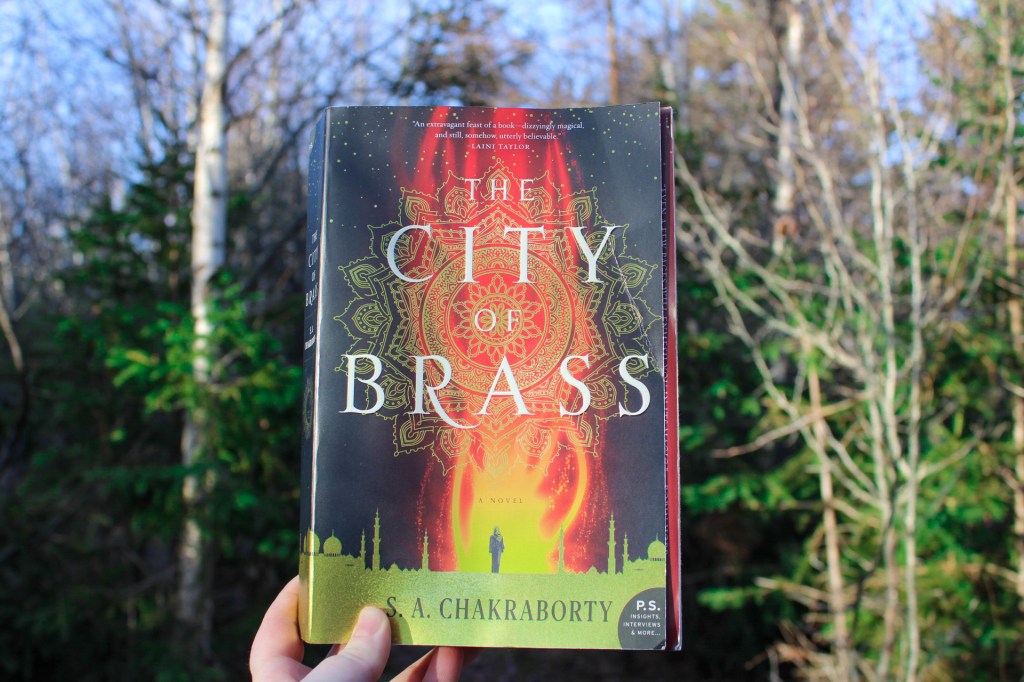
Title: The City of Brass (The Daevabad Trilogy #1)
Author: S.A. Chakraborty
Genre: Fantasy
Publisher: Harper Collins
Publication Date: 2017
Page count: 530
Rating:
The City of Brass is the first book in The Daevabad Trilogy by S.A. Chakraborty and it was one of my few five-star reads of 2022. Set in eighteenth-century Cairo and then spanning across a mythical middle east, Chakraborty weaves together a beautiful narrative from multiple perspectives of a magical society steeped in prejudice and inequality. A place where Djinn’s are real and dangerous, and everything is not as it seems on the surface. This book sat on my TBR list for a very long time and I’m now kicking myself about not getting to it sooner.
Fair warning: spoilers ahead for anyone who hasn’t read this or the other books in this series.
Book Review: The City of Brass by S.A. Chakraborty
The City of Brass begins with Nahri, a young woman in Cairo somewhere near her twenties in age and living in relative poverty, acting as a thief and con-artist to survive. She’s never known her family and has lived her entire life in survival mode, doing what she needs to in order to get by. Nahri has unique abilities as a healer that she can call upon as she needs them, though more often seems to use deception to trick wealthy officials and city dwellers out of their coin.
Chakraborty immediately focuses on building Nahri’s character as strong and independent, someone who will do what needs to be done to survive. She’s not bereft of morals, but she knows the world is not tilted in favour of the poor, and certainly not designed to help a woman succeed. She manipulates and schemes as she needs to in order to create a semi-comfortable living for herself with the goal of escaping to study her healing elsewhere, where she can be safe.
From here, the plot quickens its pace and then never really slows down again. Nahri performs a ritual she believes to be fake in an effort to make some money and accidentally summons a Djinn (or daeva) and an ifrit hellbent on killing her. She soon discovers from Dara, the daeva she summoned who now acts as her protector, that she is the last in a line of miraculous healers that were heavily worshipped in magical realms. They quickly embark on an epic journey towards Daevabad, the City of Brass, to return Nahri to her people and her rightful station.
Nahri is a wonderfully flawed character with more than just survival instincts. She’s determined to craft a life for herself where she can be free, where she can do what she pleases and serve as she sees fit, something that is denied her as a woman in both the human world and in magical realms. Chakraborty does a masterful job of allowing Nahri to explore concepts like love and friendship and commitment without losing her fire or independence. Even when placed in a traditional hierarchy, Nahri pushes back and advocates for herself at every turn, something I genuinely appreciated about her character.
Over the course of the book we’re also introduced to Ali, a prince of the reigning monarch in Daevabad whose ancestors took the city by force. Ali himself begins as a painfully narrow-minded warrior with a strong moral compass, but through his viewpoint, Chakraborty is able to really flush out the structural inequality that has grown as a result of the prince’s family empire. We see both his perspective and his family’s, learning the careful balance that they attempt to maintain in order to keep the peace among dramatically different groups of humans and djinn in Daevabad. Ali’s character is initially quite flat, but over the course of the book he flourishes and grows in ways you don’t necessarily expect. He also becomes a pivotal character in what essentially amounts to a coup.
Ali is contrasted wonderfully with Nahri, her opposite in so many ways, and yet also the closest thing she has to a friend. Everyone wants something from her, even Dara, but in the end, it is Ali who is most upfront about it, who cares enough to consider her feelings and her life as though she were more than a symbol or token to be traded. Their relationship is one of my favourite dynamics in the book because it just felt so genuine.
As a whole, I loved everything about this book. The world is complicated and nuanced, but Chakraborty’s story telling keeps everything relatively clear. The plot moved at a really great clip and had some twists that I wasn’t entirely expecting. I also really appreciated Chakraborty’s ability to build characters you really cared about. Nahri is wonderful, but Ali was a truly great way to demonstrate the complicated nature of the class structure in his world, and the battle between duty and what is right. Everything comes together for a glorious crescendo that then explodes in everyone’s face, and it feels all the more appropriate because of the inequality that was so pervasive and the power of those in charge.
I think this series has so much potential, and I’m so excited to read the next installment. Easily one of my favourite books of the year.
 forests and fiction
3 responses to “Book Review: The City of Brass by S.A. Chakraborty”
[…] The City of Brass was one of my favourite reads of 2022 and while I initially thought it would be hard for The Kingdom of Copper to live up to my expectations, it proved me wrong. This book was a wonderful build on the unique mythical middle eastern world that Chakraborty built in book one. There were heavier political dynamics, an interesting evolution of the characters, and a plot that had me staying up way too late turning pages until I finished. And the end?! I can’t even. […]
LikeLike
[…] The City of Brass […]
LikeLike
[…] The City of Brass Review […]
LikeLike